

St. Luke's Carillon


Carillon-Pic.jpgBells have been called the song and voice of humankind. St. Luke's United Methodist Church is blessed to share in that voice, with its 42 bell carillon, one of only 154 on the North American continent. From antiquity to the present, bells have tolled the hour, pealed for coronations and in eulogy, inspired and called people to worship, and sounded in joyous celebration, victory and festival. Bells have been used by all major religions except Islam, and appeared in Christian observances as early as the 6th century A.D.
History
The first known bells are credited to the Chinese and other ancient eastern peoples. From as early as 2000 to 1500 B.C., extant records disclose the skill and artistry of bell makers. The carillon evolved about the 15th century, yet dates its history from the ancient temple bells of China, Egypt and Mesopotamia. Even though metal alloys considered today to be acceptable for bells were not developed until centuries later, the temple bells of these ancient civilizations were the forerunners of modem cast bells.

As the use of metals, particularly bronze, increased, bell makers of Western Europe became world leaders in bell foundry. They continue today to produce the world’s highest quality bells. From 1370 to 1680, the skill of Dutch foundries came to the forefront, and they emerged as the world's finest creators of bells. English bell making flourished in the 19th century as British casters rediscovered secrets of 17th century Dutch and Flemish craftsmen.

Although the word "carillon" is indiscriminately applied to any assortment of bells or even electronic bell sounds, the authentic carillon is an instrument of at least two octaves of cup shaped bells arranged at chromatic intervals and tuned to precise concordant harmonies. When a bell set numbers no more than 15, is often portable, and is tuned to intervals of the major scale, it is a chime. The carillon is larger, its bells stationary, can number up to 70 bells and is more accurately tuned than a chime.

From their early use, most often in cloisters, bells usually were played singly or in groups of four and were struck with hammers. Numbers in the groupings soon increased, allowing whole melodies to be played. Mechanical devices appeared, primarily a keyboard with large wooden keys called batons, linked to the bell clappers. Foot pedals were added for the larger, deeper toned bells. This keyboard pedal combination is the playing system of the modem carillon.

Carillon-Bells.jpgAs several foundries came into existence in the 17th and 18th centuries, it was in this period that artisans began to improve the tuning of the bells by cutting away metal on the inside of the casting. This produced truer harmonic tones.

During the French Revolution and again in World War 11, many European carillons were destroyed and their metal melted for armaments. In Holland in the 1940s, Dutch citizens tried desperately to hide their bells from invading German armies, whose war time destruction of bells probably led to the upsurge of interest in bell making during the late 1940s and '50s. In the 1950s decade alone, the number of carillons in the United States and Canada doubled. A 1994 compilation by the Guild of Carillonneurs in North America listed 142 in the United States, 11 in Canada and one in Mexico.
The Gift
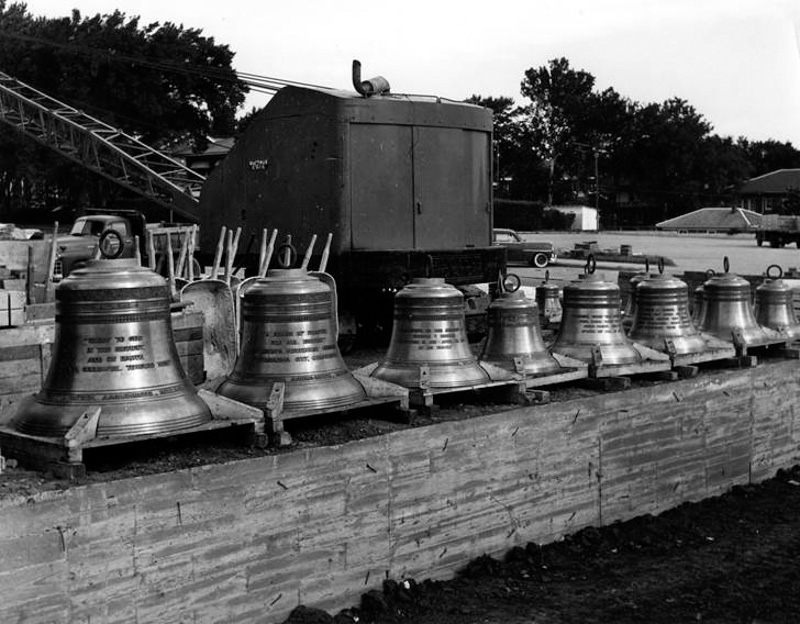
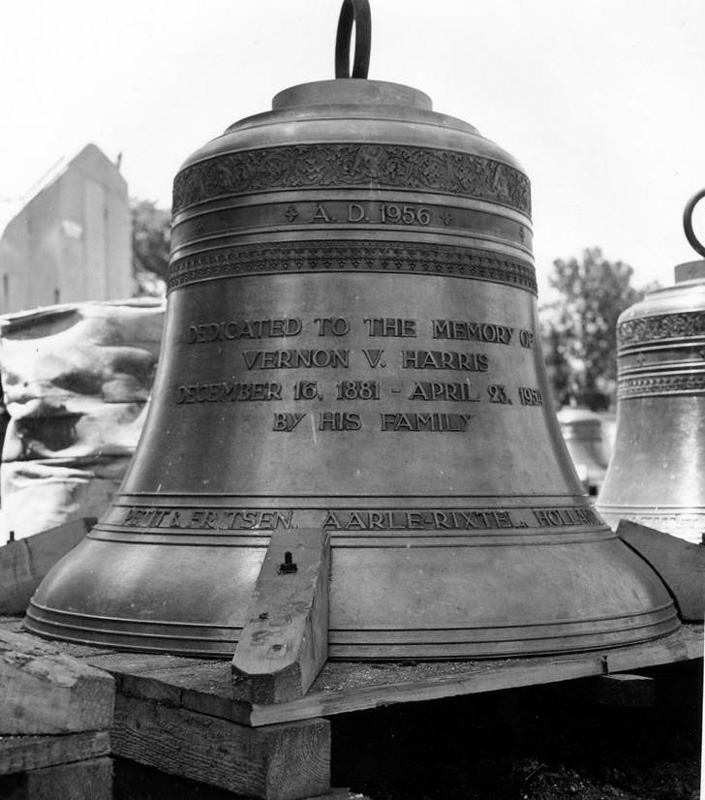
The St. Luke's bells were a gift in the mid 1950s from the late Vernon V. Harris and his family, as their part in construction of the Sanctuary. A lifetime St. Luke's member, Mr. Harris died before the carillon's dedication on September 16, 1956, and the bells are his memorial.

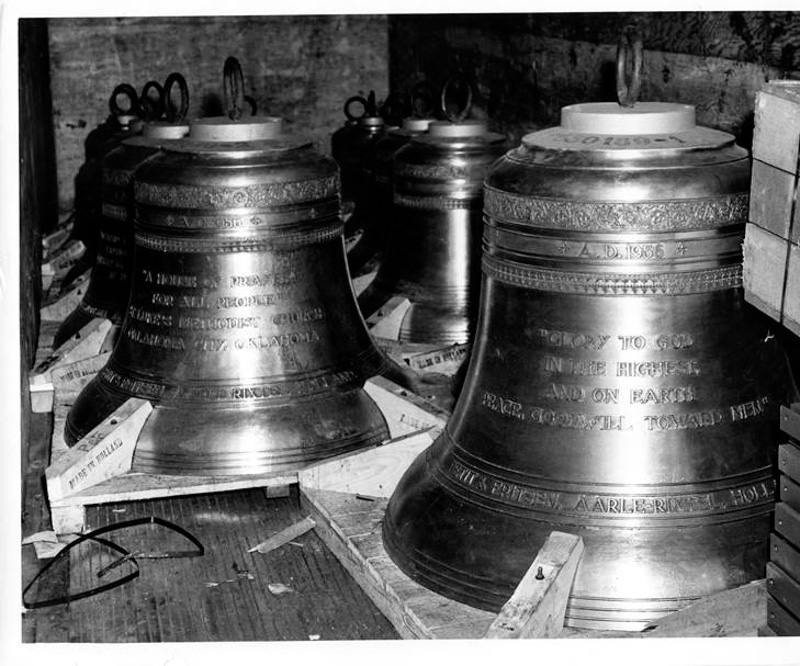
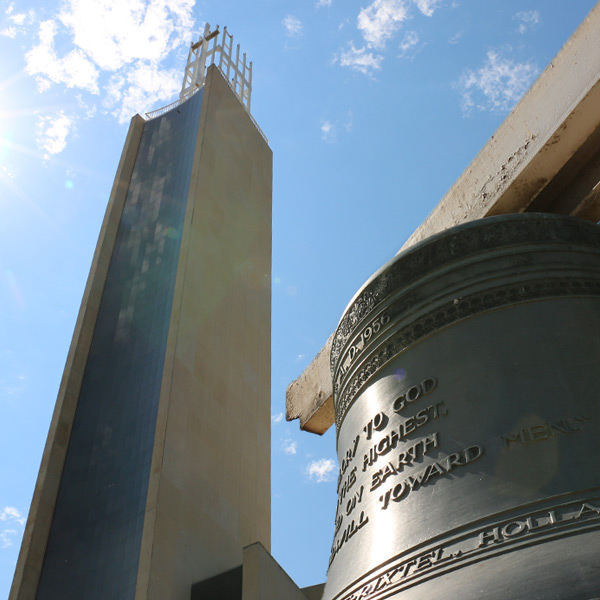
A carillon must have a tower, and the St. Luke's bell tower is 185 feet tall, designed by the church architect, Truett H. Coston of Coston Frankfurt Short (now Frankfurt Short Bruza). The carillon is comprised of 42 bells and has a musical range of four octaves. It was founded in Aarle Rixtel, Holland, by the Petit & Fritsen Ltd., Bell Foundry.

The purchase contract specifies that the "highest grade bell bronze, consisting of 80 percent red copper and 20 percent Banka tin" be used; that the bells and clappers be "free of all imperfections." The contract, dated December 27, 1955, also called for the bells to "bring forth a pure humtone with sufficient time of sounding; the tuning a pure harmony of fundamental tone with octaves, minor thirds, fifth and duodecime..." Dissonant tones specifically were "not allowed."

The 42 bells' total weight is 13,315 pounds; the clappers weigh approximately 500 pounds. Individual bells range from 20 to 3,190 pounds. The carillon is played from the clavier room, located directly below the bells at the 11 th floor level of the 14 story tower.

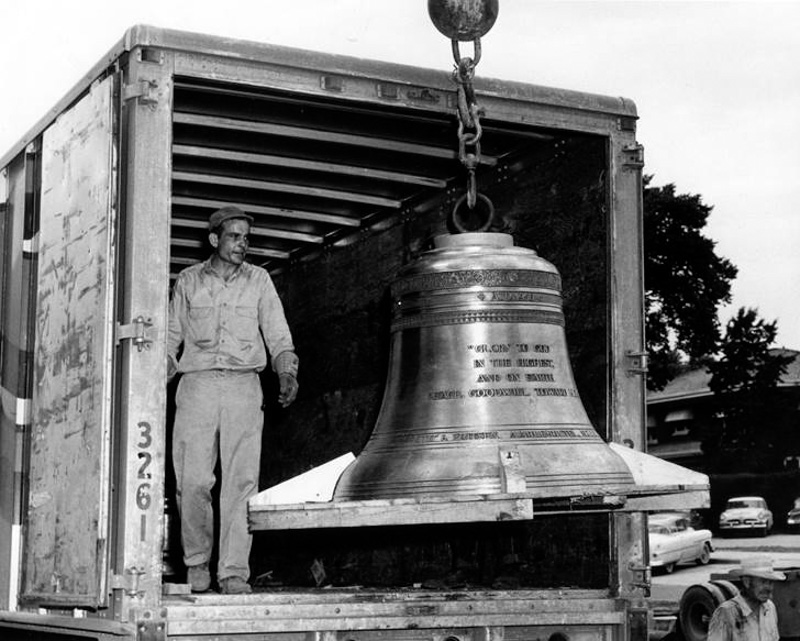
Carillon-Plaque.jpgAlthough only birds and, possibly, angels are able to see them, the five largest bells bear inscriptions. The largest bell repeats the angels' tidings to shepherds: "Glory to God in the highest, and on earth, peace, goodwill toward men." The second largest bears the psalmists exhortation: "Make a joyful noise unto the Lord, all ye lands; serve the Lord with gladness; come before his presence with singing." Another declares, "A house of prayer for all people, St. Luke's Methodist Church, Oklahoma City, Oklahoma." On the fourth: "Break thou the bread of life, dear Lord, to me   and I shall find my all in all." A fifth bell is inscribed, "Dedicated to the memory of Vernon V. Harris, December 16, 1881 April 23, 1954, by his family."

The bell inscriptions are engraved on the memorial marker mounted at the base of the tower behind the Sanctuary's northeastern arc. Besides the scriptural and St. Luke's inscriptions, the name of the bell maker, Petit and Fritsen, and their town and country are imprinted on each bell.

Church records indicate St. Luke's could have missed having a carillon. In correspondence dated December 1955, the building chairman recommended removing the carillon and bell tower elevator from the construction contract. He proposed that the bells be deferred until a $900,000 mortgage had been repaid and additional parking facilities provided. The suggestion was not endorsed.

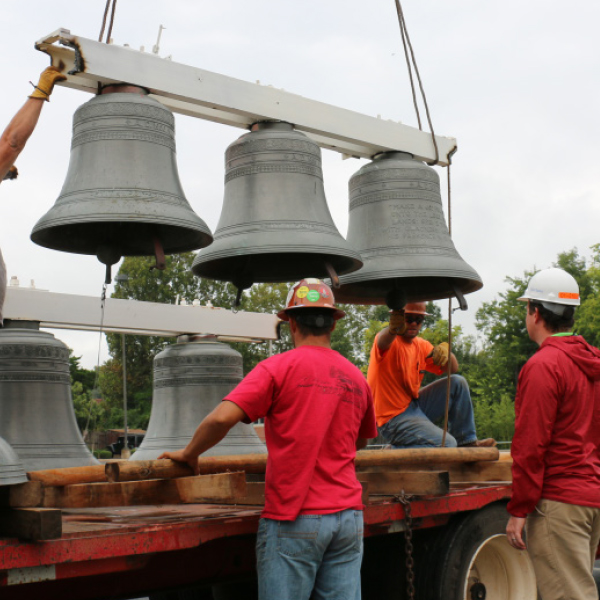
The bells were shipped from Rotterdam on May 3, 1956, on the SS Havtroll. Gerard M. Fritsen, a partner in the business, came to Oklahoma City three months later to personally supervise the installation.

At the Sunday afternoon dedication on September 16, Robert Donnell, carillonneur of the Dominion of Canada, was guest performer. Mr. Donnell regularly played the 53 bell carillon in the Peace Tower of the Canadian Parliament Building in Ottawa from 1940 1975, and was one of the few North American graduates of the Mechlin Carillon School in Belgium.

In addition to worship hours and for such joyful occasions as weddings and Summerfest, the St. Luke's carillon has sounded for solemn events. During the time American citizens were held hostage in Iran, St. Luke's bells tolled daily at noon with other bells across the United States. At the request of the federal government, churches and other institutions with chimes and carillons joined each mid day to remind Americans of the men and women then imprisoned in the American Embassy in Tehran. At the request of the Governor, the carillon was rung on April 20, 1995, honoring all those killed in the bombing of the Alfred P. Murrah Federal Building the previous day.
The Bells Today
The St. Luke's bells are part of an ancient progression. From their inception many centuries ago, bells and carillons have been the focal point of community life, the Carillon-Tower.jpghub of the market place and a gathering site for celebration and art. From the typical use of sounding the hour of noon to calling people to prayer, the carillon has evolved to use as a solo instrument with symphony orchestras. The instrument has been featured in pageants, even outdoor ballet and frequently, at festivals. It has had a dominant part in patriotic observances and dedications.

As you listen to the St. Luke's bells, imagine some of the countless jubilant occasions through the ages celebrated by the lighter melodies of a carillon. And envision those mournful events of history marked by its deep somber tones.

The late Harry Turner, a St. Luke's carillonneur, once said the carillon "serves as the voice of a congregation in its community."